
Alphabet Books
(2002). Museum ABC (1 ed.). New York: Little, Brown Young Readers.

In this alphabet book each letter is accompanied by several painting from the Metropolitan museum of art. This can expose children do are they may not have been aware of before. The back matter is a great research to teachers who like to relay added facts to their students.
Questions: Why do you think they used this picture for the letter ___?
Which picture of the apples do you like best? Why?
What is a museum? What have you seen museums?
Activity: In the dramatic play center create a class museum of student artwork. Talk about what people do at museums and even watch a few videos. Have children role play visiting a museaum.
Baker, K. (2010). LMNO Peas. New York: Beach Lane Books.

Kieth Baker draws you in with large textured bright letters and guides your eyes to the stars of the book, the peas, with the bold black print of the text. Each pea is different and unique (the theme of the book) and children will want to go back for a second and third look to see what they can find.
Questions: What is your favorite vegetable? Do you like peas?
Estimate how many peas you think are on this page?
What do you think of peas now?
What is your favorite page? Why?
What on this page starts with the letter ____.
Activity: Have each child decorate an enlarged picture of a pea with what they want to be when they grow up.
Base, G. (1996). Animalia (Picture Puffins). New York City: Puffin.

This complex animal alphabet books is a veritable turkey dinner for the eyes. Each picture features a main focus but if you let your eyes wander from the incredibly detailed and lifelike animals you will find other little treasures. Children will have fun looking for all the objects starting with the pages sound.
Questions: Name all the object you see in this picture that start with the sound of ___?
-Flip to a random page in the book and cover the letter. Have the children guess the letter by looking at the picture.
-Raise your hand when you hear the sound of ___.
Activity: Have the children find all the items in the room that start with ___.
Bayer, J. E. (1992). A, My Name Is Alice. Ill. Kellogg, S. New York City: Puffin.

This well known jump rope song is brought to life by Steven Kellogg with his use of ink and pastel line with watercolor washes. These personified animals draw the reader in with silly faces and kind eyes.
Questions: Have children predict the ending of the sentences by looking at the page.
-What else could Alice sell?
-What could you sell if you were in the rhyme?
Activity: Shared writing: As a class come up with a list of things each child could sell if they were in the picture book.
Bolster, J., & Pallotta, R. (2006). The Construction Alphabet Book . Ill Bolster, R. Watertown, MA: Charlesbridge Publishing.
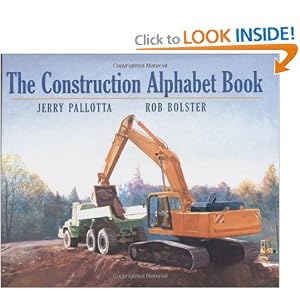
In this picture book the reader learns about the alphabet but also about different
construction equipment. The watercolor pictures are very lifelike with the shadow particularly well done.
Questions: What kinds of heavy equipment/trucks do you already know about?
-What is your favorite truck/equipment in the book, why?
-What do you think this truck’s job is?
Activity: Put several copies of this book in the construction center. Have the children build the letters out of wooden blocks. Have several toy trucks in the center for the children to explore as well. Scaffold the children and discuss what they are building.
Catalanotto, P. (2002). Matthew A. B. C. New York: Aladdin Paperbacks.

In this unique alphabet book Catalanotto uses water color to create and unusual classroom where all the students are named Matthew. Children won’t be able to keep themselves from laughing when they see all the interesting ways their teacher tells them apart. While the letters are used here they are not the main focus.
Questions: Cover up the last word on the page and have them guess. (Matthew K. is usually fond of ______)
Have children brainstorm what the word perplexed/queasy/fond mean in
context.
Why do you think Matthew J. is sleeping on the J page?
Activity:Brainstorm and have students come up with a page for their own name.
Example: Alycia is always to antsy.
Elting, M., & Folsom, M. (2005). Q Is for Duck: An Alphabet Guessing Game. Ill. Kent, J. New York: Clarion Books.

Children will make new associations with the letters/sounds in this alphabet guessing book. One page says, “B is for Dog Why? Because dogs eat bones” these simple riddles will have kindergarten and preschool children picking up this book again and again. The illustrations are done is a warm color scheme of oranges, reds, and yellows. The colors are not too over stimulating, perhaps to put the focus on the riddles which are already getting the readers brains warmed up!
Questions: -What letter makes the /b/ sound?
- Is this right B is for Dog?
- After the children get the hang of it have them guess the rest of the riddles.
Activity: Brainstorm with children and make up class riddles. Post them on a hall bulletin board and challenge other classes to solve them.
Ernst, L. C. (2004). The Turn-Around, Upside-Down Alphabet Book. New York, NY: Simon & Schuster.
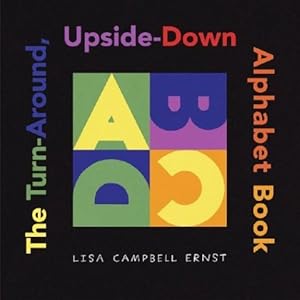
Ernst created this alphabet with cut paper which pops against the dark black background. The letters in this alphabet book can be turned around and upside down to create different objects. The test circles the book allowing the reader to turn the book to see these hidden picture.
Questions: -What do you see in this picture?
-What do you see now?
-Before turning the page have the children guess at what the next letter will turn into.
Activities: Have children add drawings to letters to turn them into something different. Create a class book.
Gag, W. (1933). The Abc Bunny . Minneapolis: University of Minnesota Press.
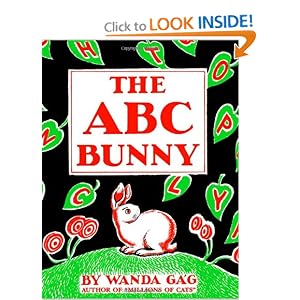
In this classic alphabet book Gag uses artfully shaded animals going about their days to depict the letters and sounds of the alphabet. The rhyming text will be pleasing to the ears of preschool and kindergarten children.
Questions: Cloze activities/Have the children finish the rhymes on the pages.
Which two words on these pages rhyme?
On M page ask: How do you think the rabbit got through the fence?
Activity: Rewrite in book form and have children create their own illustrations for the book in the style of the author.
Gerstein, M. (2001). The Absolutely Awful Alphabet. London: Voyager Books.
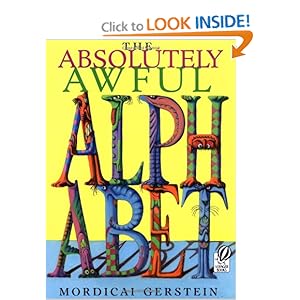
At first glance each of the letters in this alphabet book they just look like letters. Take another glance and you will see silly and monster like creatures. These letters done in oil paints and pen and ink will have the reader both laughing and scratching their head. The text offers wonderfully sophisticated vocabulary that will loan itself to teachable moments.
Questions: -What do you think pulverize/quizzical/vile means?
-As you turn the page have children make the sound the letters stand for before reading the page.
Activities: -Children can color in letters making them into different creature. Then they can vocalize which letter they have and what their creature is.
Johnson, S. T. (1999). Alphabet City. New York City: Puffin. (Original work published 1995)

Do you see the letters all around you? They are there take another look! In this book Johnson makes the reader take a second look at the world around them by presenting us with everyday objects that are the shape of different letters. Children will be asked to generalize the alphabetic knowledge to not just the printed word.
Questions: Do you see any letter in this room?
Do you see any letters that are not on paper?
What letter do you see on this page? What sound does that letter stand for?
Activities: Have children look around the room and find object that look like letters. Encourage children to build letters with blocks, counters, scrap paper etc.
Lionni, L. (2004). The Alphabet Tree. New York: Knopf Books For Young Readers.

Oh no! The letters have all been tossed up by a windstorm! In Lionni’s signature simplistic style he tells the story of a bug that teaches the letters to make words and then sentences. Instead of just naming objects or animals for each of the letters this alphabet book tells a story.
Questions: Why do we have letters?
When you put letters together what do you make? When you put words together what do they make?
What do you think will happen to the letters now that they are all mixed up?
Activity: Make a class letter tree. Have the children take turns putting the letters back in order and making simple words. Have word card available for children who are at different skill levels.
Micklethwait, L. (1996). I Spy: An Alphabet in Art (I Spy Series). New York: HarperTrophy.

In this alphabet book famous paintings accompany each letter allowing young readers exposure to artwork for perhaps the first time.
Questions: -Have children guess what the object that starts with each letter is.
-What is your favorite painting why?
-How does this painting make you feel?
Activities: Play I spy with letters with the students in small groups.
Pelletier, D. (1996). The Graphic Alphabet (Caldecott Honor Book). New York: Scholastic.

“The Graphic Alphabet” lives up to its name, all of the art was done and reproduced digitally. Although the letters have been manipulated in complex ways the ideas are concrete. Children will have fun seeing how Pelletier alters the letters to create pictures.
Questions: -Flip to a random page and have the children say what letter is pictured. Have the students try to
figure out what is pictured.
-What do you think and avalanche is? Discuss this vocabulary and how it is pictured in the illustration.
Activities: Compare and contrast this book with “Alphabet City”. Look at the letter “B” in one and compare it to the other. Discuss as a class how they are different and how they are the same.
Shannon, G. (1999). Tomorrow's Alphabet (Mulberry Books). Ill. Crews, D. New York: HarperTrophy.
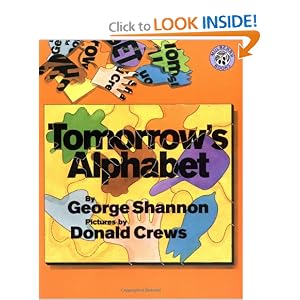
Large colorful images that take up most of the page accompany the brain stretching riddles. How can A be for seed? How can H be for Yarn? Open this interesting alphabet concept books and find out. Similar to “Q is for Duck” this book will have readers looking at the alphabet in a different way.
Questions: -Why do you think this is called tomorrow’s alphabet? -Ask again after reading
-Have children guess the answers to the riddle. Be sure to cover up the picture as the answer is on the same page.
-Compare this book to “Q is for Duck”. How are they the same? How are they different?
Answer: Create some of these riddles as a class!
Smith, R. (2008). An A to Z Walk In the Park (Animal Alphabet Book) (1st ed.). Calumet: Clarence-Henry Books.

This alphabet book features 200 animals both easily recognizable and rare! At the alphabet zoo the animals aren’t organized by species but by the first letter of their name. Although the text is somewhat contrived using this book lends itself to the discovery of new animals.
Questions: -Which animals do you know the name of in this picture?
-Have children predict what animals will be pictured next.
Activity: As a class research some of the unknown animals online. Learn about them through websites, video and other picture books.
APA formatting by BibMe.org.
Pictures from amazon.com
