
Part 1
I chose to look at and analyze picture books across six decades, particularly Caldecott Winners or Honors books. By doing this I can learn more about what to expect when opening up books from different decades and enrich my read alouds by understanding how the illustrations and stories have changed. I have found that children love to know about how pictures are made and also about the authors and illustrators. The more I know the more I can share with student thus improving their ability to make connections, retell the story, etc.
1.1 , 1.2 , 1.4 Students communicate with others to create interpretations of written, oral and visual texts
Answer literal and easy inferential questions about texts read aloud.
1. Retell information from a story, using proper sequence.
2. Identify the setting, theme, conflict, and important events of the plot in a story.
Make text-to-self connections.
3. Identify the specific purposes of a text, e.g., to find information, to enjoy a story, to receive a message.
4. Express opinions about texts and the reasons why, e.g., I liked …, I did not like …
Part 2
1950s

Milhous, K. (1950). The egg tree story and pictures. New York: New York: Charles Scribner's Sons.
The end of World War II gave way to an increased interest in children’s librarys and picture books. During this time many new authors and illustrators began to create children’s books (Matulka, D., 2008) “The Egg Tree” was one award winning book that came out of the 1950s. In this Caldecott winning story about a Dutch family celebrating Easter Milhous uses muted colors to illustrate the book. Well muted colors by today’s standards, by the standards of the 1950s the colors in Milhous’ book were considered bright. Printing in color was very expensive in the fifties. Throughout most of Milhous’ book the colors are red and grey. Only in a few pictures where the eggs are featured are more varied colors used. This is a wonderful design choice that really makes the eggs pop out as the central focus of the story. Also of note is the plot of the story that is about a normal family celebrating together rather than the fairy tales that were scene in many children’s books preceding the 1950s. This story can still be enjoyed by the children of today.
1960s

Keats, E. J. (1962). The Snowy Day. New York: New York Viking Press .
In the 1960s the book format that we are familiar today took off because of this many artist experimented with different mediums and techniques (Matluka, D., 2008). One of the most recognizable books from the 1960s is the 1963 Caldecott winning “The Snowy Day” by Ezra Jack Keats. This book also marks the first African American character pictured in a story book. Keats experimented with medium here by blending gouache with collage. This method was different from the woodcuttings and other methods from the past. In “The Snowy Day” Keats uses bright colors and block like shapes to depict a child’s day in the snow. Many of the backgrounds in the illustrations are bright unconventional colors such and hot pink and orange. These illustrations are also unique because they lack facial detail without taking away from the emotional feel of the book. In looking at many other books from the sixties the medium and method used here seems very unique for its time.
1970s

Hogrogian, N. (1974). One Fine Day. New York: Aladdin.
Hogrogian uses bleeding images of water color to illustrate a Fox’s quest to retrieve his tale in this 1975 Caldecott winning picture book. This award winning story is timeless and still relevant today. Hogrogian shows the sadness that the fox feels by painting him with a turned down head and partially closed eyes. As he looks up at the old women with a pleading gaze the reader truly feels sympathy for his predicament. You can’t help but wish she would give it back right then and there. Although the illustrations are simple they have the ability to convey the emotions behind the story quite well. Hogrogian marks the passage of time in the foxes “One Fine Day” by including a bright yellow sun which moves across the page and begins to set as the reader turns the pages. This picture book has withstood the test of time and is still being sold today.
1980s

Yorinks, A., Egielski, R. (Illus)(1989). Hey, Al. New York: Farrar, Straus And Giroux (Byr).
In the 1980’s authors and illustrators continued to explore the possibilities of picture books. There was an increase in social consciousness which was present in picture books as well as an increase in multicultural images in the later part of the decade (Matluka, D., 2008). During this time Richard Egielski illustrated and won a Caldecott for “Hey Al” written by Arthur Yorinks. Richard Egielski was known for his quirky and original style. In “Hey Al” Egielski use this original style to tell a story of a man named Al who is bored with his life but in the end learns to appreciate all that he has.
The browns and tans of Al’s apartment gives it the mundane feeling that Al is experiencing and the framed nature of the illustrations make it looks small and cramped almost like a stage set. When Al leaves his apartment the scene opens up to a double page spread just like Al’s world is opening up and changing. The colors also become more diverse and vibrant. In the end the image of Al returning to his small room is truly heartbreaking with the only pop of color the dog’s dish. Happily, in the end the room is brightened with a pop of color when everything is resolved. This is also evident in the bright yellow end pages that differ from the front end pages that are beige.
1990s
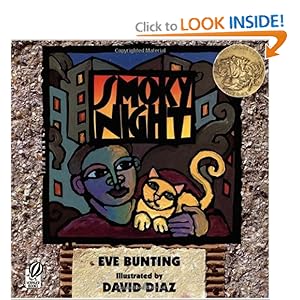
Bunting, E., & Diaz, D. (1994). Smoky Night. New York: Harcourt Children's Books.
During the 1990s technology was developed that allowed children’s book illustrators to use new techniques to create their artwork. The lithographic processes were improved which allowed easier reproduction of complicated artwork. During the 1990s the first picture book using a digital medium was produced (Matluka, D., 2008). In the 1995 Caldecott winning Smoky Night (written by Eve Bunting) is an example of a book that could not have been done even a decade earlier due to both its content and technique. Diaz uses a combination of paint and collage to tell the story of a boy and his mother during the Los Angeles riots. When the character of Mama is explaining the riot the background to the text features red crumpled paper bringing about a feeling of danger. When the market is being looted the background is a collage of cereal and other foods. The people themselves are all the same mixture of pinks, purple, blue and oranges even though the text tells us they come from different cultures. This is perhaps to represent how we are all similar and need to work together to get through challenging times.
2000s and beyond!

-Irvine, M. (2003). Ella Sarah Gets Dressed. New York: Harcourt Children's Books.
In the first decade of the 21st century technology just keeps getting better and more sophisticated. The sky is the limit! Picture books are now being produced digitally. An artist can paint and create the old fashioned way and then take a picture/scan of their work to then be reproduced! This opens up a world of possibilities. Now artists can use any medium they like to create their illustrations, photographs, clay, stain glass or they don’t have to use any tangible medium at all. Some illustrators are now creating illustrations digitally. Digital illustrations can be made to look like most mediums, even paint! Artists are also working on tablets that allow what they draw on the tablet to be seen on the computer screen. The possibilities are truly endless.
“Ella Sara Gets Dressed” a 2004 Caldecott Honor book Irvine uses printmaking techniques on rives paper to create the familiar story of little girl who wants to dress herself. The stage is set with the brilliant orange and pink polka dot end pages. Irvine’s use of simple geometric shapes as facial features show how Ella is feeling when her mother tells her what to wear The bright colors and geometric design seem to represent the main character’s outrageous wardrobe choices throughout. In the end Ella’s choices do not disappoint as her friends join her in the fun.
Over the past six decades picture books have changed immensely. They have gone from a simple format to a genuine art form. In the past illustrators were held back because of the available printing techniques, now that challenge no longer exists. Like Ella illustrators have a closet of possibilities in front of them and all they have to do is reach in and get inspired.
Resources
Bunting, E., & Diaz, D. (1994). Smoky Night. New York: Harcourt Children's Books.
Chodos-Irvine, M. (2003). Ella Sarah Gets Dressed. New York: Harcourt Children's Books.
Keats, E. J. (1962). The Snowy Day. New York: New York Viking Press .
Hogrogian, N. (1974). One Fine Day. New York: Aladdin.
Matulka, D. I. (2008). A Picture Book Primer: Understanding and Using Picture Books. Englewood, Colorado: Libraries Unlimited.
Milhous, K. (1950). The egg tree. New York: New York: Charles Scribner's Sons.
Wiesner, D. (2001). The Three Pigs. New York: Clarion Books.
Yorinks, A. (1989). Hey, Al. New York: Farrar, Straus And Giroux (Byr).
Online resources:
http://www.ezra-jack-keats.org/index.php?option=com_content&view=article&id=51&Itemid=62
Books in Print Online Database
Contemporary Authors Online, Gale, 2009.
